
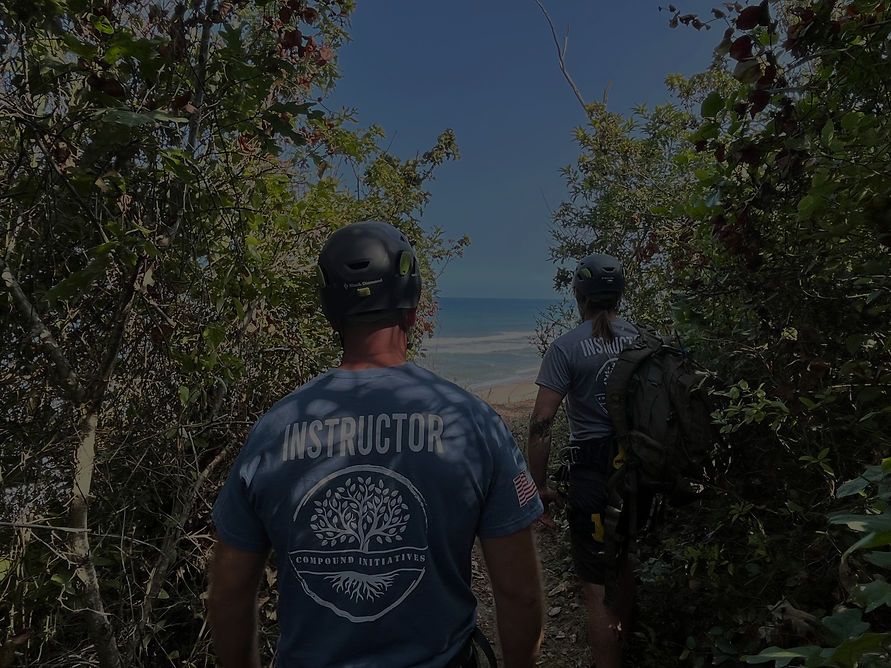
COLLABORATION TO REDUCE FRAGILITY
Adaptive training built through collaboration, scenarios, and experience.
Compound Initiatives delivers adaptive medical, rescue, and leadership programs shaped by decades of global field experience.

As a disabled, veteran-owned company, we replace passive instruction with immersive, scenario-driven training that changes behavior under stress.
Our programs are mobile, scalable, and designed to work where people actually live, work, and operate — not just in ideal conditions.

Compound Initiatives was founded by Aaron Cestaro in Massachusetts as a mission-driven, disabled veteran-owned company.
Our team blends experience from former U.S. special operations personnel and seasoned nonprofit field workers, with decades spent operating across multiple continents.
We design training the way real missions work: immersive, scenario-based, and adaptable to any environment or resource level.
Our methodology emphasizes performance under stress, realistic role players, and portable curricula that can be repeated, scaled, and sustained over time.
Beyond training delivery, we contribute to global best practices in austere operations and support nonprofits and communities through knowledge exchange, capacity-building, and collaborative program development.

We focus on three core pillars that reduce fragility at the individual, organizational, and community level.
Each can stand alone...or combine into a long-term capability-building pipeline.
Training
Training isn’t just skill acquisition
— it’s behavior change in emergencies.
We deliver practical, scenario-based medical and rescue training designed for real environments.
Our programs move beyond rote skills and check-the-box certifications, focusing instead on decision-making, communication, and coordinated response under stress.
Organizations often outgrow one-off classes when they realize the training doesn’t map to their actual operating environment. When training isn’t standardized internally, communication breaks down first — not individual skills.
Durable capability means maintaining a cadence: drilling fundamentals, validating them through realistic scenarios, and adapting as hazards and environments change.
Our training builds reproducible results, not one-time performance.


Examples of our training include:
-
Stop the Bleed
-
American Heart Association BLS & First Aid
-
Water Rescue
-
High-angle Rope Rescue Fundamentals
-
Wilderness & Urban Austere Medicine
-
Low-light Medical Skills
-
Program Development (SOPs, Train-the-Trainer, Instructor Pathways, Emergency Action Plans)


Guided Experiences
Guided experiences are how we train situational awareness, communication, and emotional regulation.
These immersive field sessions apply medical and decision-making skills across natural, urban, and transitional environments.
We use nature-guided experiences, urban walks, and scenario-based interactions to sharpen perception, coordination, and calm under pressure.
Removing screens, rigid schedules, and normal roles — especially in multi-day formats — creates true immersion. Participants rediscover effective communication, breathing control, and awareness while operating in unfamiliar or stressful conditions.
These are not recreational retreats or symbolic challenges. They are structured experiences that raise practical baselines and translate directly into real-world performance.
Examples of our guided experiences include:
-
Nature Immersion & Movement Sessions
-
Observation & Field Awareness Drills
-
Survival & Wilderness Mobility
-
Seasonal Creative Retreats
-
Leadership & Team Development Retreats
-
Executive Retreats
Outreach
Community outreach is how training becomes globally applicable.
We collaborate with schools, nonprofits, and community groups to build locally owned emergency capability through shared learning and scenario-based validation.

Our focus is capacity-building — not dependency on outside experts.
Knowledge exchange allows us to refine training methodologies across cultures, languages, and resource levels. We work toward relevant activities that can be adapted regardless of prior experience or infrastructure.
Success means that after we leave, communities are confident, capable, and equipped to run their own programs — supported by practical certification, realistic scenarios, and locally relevant emergency action plans.


Examples of our outreach include:
-
Community training initiatives
-
School support programs
-
Cross-cultural program development
-
Parallel support for NGOs, volunteers, and local responders
-
Global knowledge-exchange missions
Past Events
In addition to our regularly scheduled training programs, Compound Initiatives supports select events that demonstrate how our methodology performs in real environments.
These highlighted engagements showcase scenario-based instruction, public-facing education, and instructor-led medical support adapted to the needs of each audience.
Sea Cadets, Newport RI
We've spent three consecutive years delivering hands-on medical readiness training focused on bleeding control, situational awareness, patient movement, and confidence under pressure for Sea Cadets.
Our instruction is adapted for youth leadership and austere response considerations within a maritime context.

Ninja Warrior Course, Fayetteville NC
We provided on-site Stop the Bleed and first aid support during a Ninja Warrior course designed for military service members and their families, reinforcing safe participation and rapid response in a dynamic environment.
We trained over 100 volunteers, participants and military community members in ACS Stop the Bleed.

WIND Fest, Cape Cod MA
We supported the first annual WIND Fest community watersports event with bleeding control education and scenario-based medical instruction.
We tailored our demonstrations and training scenarios to integrate water-based rescue, casualty stabilization, and patient transfer for water sport enthusiasts.

Testimonials

The Stop the Bleed course, led by Aaron and his colleagues was invaluable for giving me hands-on, practical knowledge of what to do in a medical emergency in the middle of the jungle.
I loved that there were very few slides and instead, many practical demonstrations and exercises. The most impressive part of the course was a series of very realistic emergency scenarios where Aaron acted as a patient in shock, wearing props with wounds simulating actual bleeding.
This was an invaluable opportunity to practice what I learned and be mentally prepared for a real emergency.
Pavel Maximov - Stop the Bleed Graduate, Thailand
I absolutely loved the hands-on training and the skills these guys provided me with.
It’s given me a deeper understanding of bandaging, trauma care, and treating to stop the bleed, along with basic life support.
The class was amazing — truly one of the best training experiences I’ve ever had.
Thank you so much!
Jude Klein - BLS Provider & First Aid / Stop the Bleed Graduate, USA

_HEIC.png)
Aaron, thanks for the chat and visiting at the ninja course at Rick's [Place].
I wanted to share my daughters cartoon sketch of what she learned :)
What you're doing is wonderful!
Melissa Roland, USA
Compound Initiatives supports civilian instructors, organizations, and community groups seeking training that holds up outside the classroom.
We focus on how people actually perform in emergencies — limited information, imperfect conditions, and human stress. By combining evidence-based medical principles with scenario-driven instruction, we help individuals and teams build durable skills that translate into real-world action.
Interested in training, collaboration, or bringing a program to your community?
Reach out below and let’s start the conversation with a free consult.